
At a glance: choosing an industrial generator
- Start with the electrical load your business needs to support, including any equipment with higher starting-power requirements.
- Think about how the generator will be used. Occasional backup power and regular site use can call for very different setups.
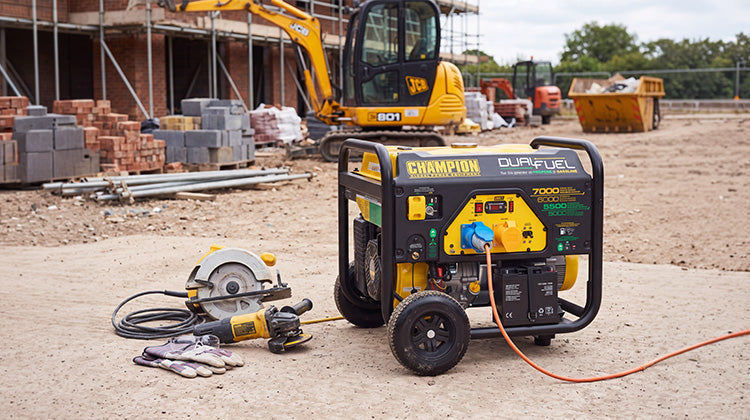
- Petrol and dual-fuel generators can suit many professional applications, particularly where portability and flexible use matter.
- Diesel becomes more relevant for larger loads and sustained running, but the right fuel still depends on how you'll use the generator.
- Check phase, runtime, fuel use, noise and installation requirements alongside the headline power output.
An industrial generator needs to do more than produce enough power on paper.
For a business, the real question is whether it can support the right equipment, for the right length of time, in the way your operation actually needs.
That might mean keeping refrigeration running during a power cut, supplying machinery on a site without mains power or moving a generator between jobs.
Before you compare generators, there are four decisions that will shape the right setup.
1. Decide what absolutely needs power
Start with the equipment the generator must support.
That could include:
- Machinery and workshop equipment
- Pumps and compressors
- Refrigeration
- Lighting
- Security systems
- IT and communications equipment
- Construction tools
- Agricultural equipment
- Site facilities
The important distinction is between everything your business owns and everything that genuinely needs generator power.
If the generator is for backup, you may only need to protect essential systems rather than the whole premises.
If it’s for day-to-day site power, your normal working load becomes more important.
Reducing the load to what actually needs to run can make a significant difference to the generator size you require.
2. Calculate the load, not just the number of machines
Once you know what will be powered, look at how much electricity that equipment demands.
Running wattage tells you how much power equipment uses during normal operation.
Starting wattage matters because motors, pumps and compressors can briefly demand more power when they start.
Crucially, you also need to establish which machines will operate at the same time.
For example, three pieces of equipment rated at 2kW each don’t automatically mean you need 6kW of generator output if they’re never used together. Equally, a generator sized only around running wattage may struggle when a larger motor starts.
For straightforward setups, you can estimate the load from equipment specs.
Larger systems, complex machinery and permanent installations may need a professional load assessment before choosing a generator.
3. Check whether your equipment needs single-phase or three-phase power
For commercial and industrial applications, phase is just as important as total output.
Single-phase generators can supply many tools, appliances and smaller commercial loads.
Three-phase generators are used where equipment such as larger motors, machinery or industrial systems requires a three-phase supply.
Check the electrical requirements of the equipment before you choose.
If you need three-phase power, don’t assume the generator’s total rated output is available from one socket or one phase. How the load is distributed across the phases is important.
For more complex three-phase installations, the generator and load should be assessed together by a suitably qualified professional.
4. Match the generator type to the workload
Commercial use doesn’t automatically mean diesel.
The better choice depends on how much power you need, how long the generator will run and whether it needs to move.
If the generator needs to move between jobs
A petrol generator can make sense for trades, workshops and temporary site work where portability is a priority. Some generators like the Champion SitePro 3000 have a heavy-duty frame fitted with a lifting eye, built specifically for transport and rugged use.
However, it’s worth looking beyond output. Wheels, handles, dimensions and weight can all affect how easy the generator is to use regularly.
If you want a choice of fuels
A dual-fuel generator lets you run on petrol or LPG.
That can suit businesses that already use LPG or want to take advantage of the many benefits of running a generator on LPG.
Check the rated output on both fuels. Some dual-fuel generators provide less power on LPG than petrol.
If the load is heavier or running periods are longer
A diesel generator is the logical option where sustained operation, larger loads or higher outputs take priority over portability.
That doesn’t make diesel the automatic choice for every business.
A compact trade setup and a permanent backup installation have very different requirements, even though both are commercial applications.
Is the generator for regular power or emergency backup?
This is one of the biggest differences between business generator setups.
A generator used every working day needs to suit the normal workload, operating hours, fuel requirements and refuelling routine.
A backup generator has a different job. It may spend most of its life switched off, then suddenly need to supply essential equipment during a mains failure.
For backup power, decide what needs to remain operational during an outage.
That might be:
- Refrigeration
- Critical machinery
- Lighting
- Security systems
- IT and communications
- Pumps and controls
You also need to decide how power will transfer from the mains supply to the generator.
A manual changeover arrangement requires someone to intervene.
Where automatic backup is required, a compatible automatic transfer switch can form part of the setup. The generator, ATS and electrical installation all need to be designed to work together.
Will the generator run for two hours or all day?
Runtime figures deserve context.
Manufacturers normally quote runtime at a stated percentage of the generator’s load. A figure measured at 50% load will not necessarily reflect what you will achieve when the generator is operating much closer to its rated capacity.
For regular commercial use, look at:
- Expected hours of operation
- Typical load during those hours
- Fuel tank capacity
- Fuel consumption
- Refuelling access
- Whether the equipment can be stopped for refuelling
The goal isn’t simply to find the biggest fuel tank.
You want a generator that can support your working pattern without unnecessary interruptions or excessive fuel use.
Where will the generator actually operate?
A generator that works well in one environment may be poorly suited to another.
Think about the physical location before you buy.
A mobile generator may need to be lifted, wheeled or transported regularly. A fixed backup generator raises different questions around installation, ventilation, access and servicing.
Noise can also become a bigger issue around:
- Employees
- Customers
- Neighbouring businesses
- Residential properties
- Indoor working areas close to the generator location
Compare published dBA figures carefully because measurement distance and operating load can affect the result.
For smaller applications, an inverter generator may suit situations where lower noise and portability matter. Larger installations may call for an enclosed generator designed to reduce operating noise.
Don’t treat maintenance as an afterthought
If your business depends on the generator, maintenance becomes part of keeping the operation running.
Follow the servicing schedule for the specific model and keep track of operating hours.
Depending on the generator, checks and servicing may cover:
- Engine oil
- Oil and air filters
- Fuel filters
- Spark plugs on petrol models
- Starting battery
- Fuel system
- Coolant where applicable
- General condition and leaks
Watch for changes in starting, unusual noises, leaks, warning lights or unstable output.
Backup generators also need attention even if they rarely accumulate many running hours. Low use does not remove the need for inspection, testing and scheduled maintenance.
A quick way to narrow down the specification
Rather than starting with a generator model, match the requirement to the priority.
| Business requirement | What to prioritise |
|---|---|
| Mobile trade or site work | Portability, suitable rated output and easy handling |
| Machinery with motors or compressors | Starting demand and sufficient capacity |
| Three-phase industrial equipment | Correct phase supply and load distribution |
| Long daily running periods | Runtime, fuel consumption and refuelling |
| Emergency backup | Essential-load sizing and changeover method |
| Permanent installation | Electrical design, ventilation, access and servicing |
| Noise-sensitive location | Noise level, positioning and enclosure |
This approach will get you much closer to the right generator than simply comparing maximum output figures.
Specify the job first, then choose the generator
For a business, buying too little capacity can leave equipment struggling when demand rises. Buying far more than you need can mean paying for output, fuel use and physical size that adds nothing to the job.
Think about the equipment, load, phase and operating pattern first.
The generator choice becomes much clearer after that.
If you’re working through a commercial, site or backup power requirement, use our chat system to list what you need to run and how the generator will be used and we can narrow down the options that fit the job.


