
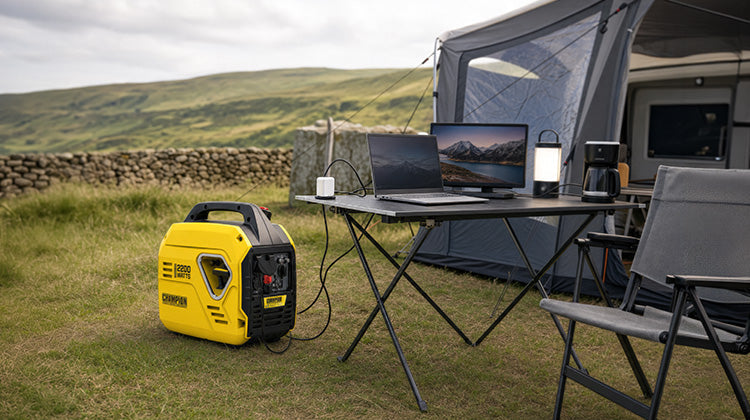
At a glance: choosing a camping generator
- Start with what you actually want to power, then calculate the running and starting wattage you need.
- A compact inverter generator is often a strong choice when lower noise, portability and powering electronics are priorities.
- Petrol generators offer straightforward portable power, while dual-fuel models give you the choice of petrol or LPG.
- Don’t buy more power than you need. Higher output can also mean more weight and bulk to carry.
- Check campsite rules before your trip as some sites restrict or prohibit generator use.
A camping generator gives you portable power when you’re away from the mains, whether you need to charge devices, run lighting or power a few appliances.
The right generator should give you enough output without becoming a burden to transport, store or run around other campers.
For most camping setups, we’d start with a compact petrol or dual-fuel inverter generator rather than something built for heavier-duty use.
Once you know roughly how much power you need, compare generators by output, noise, fuel type, weight and size.
What size generator do you need for camping?
There's no single wattage that suits every camping setup. Someone charging phones and running a few lights needs far less power than someone using several higher-wattage appliances.
Start by listing what you'll connect to the generator. This might be:
- Phone and tablet chargers
- Lighting
- Laptop chargers
- Portable fridges or coolers
- TVs
- Kettles
- Other small electrical appliances
Check the running wattage of anything you expect to use at the same time. You should also allow for starting wattage where applicable. Equipment containing a motor or compressor can briefly draw more power as it starts.
Getting the generator size right gives you enough output for your equipment without choosing a larger, heavier generator than you actually need.
Is an inverter generator best for camping?
An inverter generator is often well suited to camping because it combines portable power with controlled electrical output.
Unlike a conventional generator, an inverter model electronically processes the electricity it produces. This makes it a strong choice for electronics such as laptops, TVs and chargers.
Many portable inverter generators also combine lower noise levels with compact dimensions, which matters when everything needs to fit into a car, campervan or trailer.
You still need enough output for your equipment, though. Check the rated wattage before buying, especially if you plan to run higher-demand appliances.
How quiet should a camping generator be?
Noise matters when you’re camping.
Even a compact generator can become intrusive on a quiet site, particularly when pitches are close together.
Generator noise is normally stated in decibels, or dBA. When comparing models, check the distance and test conditions used for the measurement. A figure measured at seven metres shouldn’t be directly compared with one measured much closer to the generator.
If keeping noise down matters, inverter generators are a strong place to start.
But don’t choose based on the lowest dBA figure alone. You still need enough output and a generator that’s easy enough to transport.
Is a petrol generator good for camping?
A petrol generator can work well for camping when portability and straightforward refuelling matter.
Compact petrol inverter generators come in different outputs, so you can choose one that more closely matches what you plan to power.
Compare weight and dimensions alongside wattage.
If you’re lifting the generator in and out of a car or storage compartment regularly, those numbers can matter just as much as the headline power output.
What about a dual-fuel camping generator?
A dual-fuel generator lets you run on petrol or LPG.
That gives you more choice on the road, particularly if you already carry LPG as part of your camping setup.
LPG also doesn’t deteriorate in storage in the same way as petrol, which can make fuel management easier when the generator spends long periods between trips. LPG generators also tend to have lower emissions and offer a host of other benefits.
Check the rated output on both fuels before choosing. Some dual-fuel generators produce less power on LPG, so make sure your preferred fuel still gives you enough capacity.
How much runtime do you need when camping?
You may not need your generator running continuously throughout the trip.
Think about how you’ll actually use it. You might only run it for short periods to charge equipment, or you may need several hours of power for appliances.
When comparing runtime figures, check the electrical load used for the manufacturer’s test.
A generator can run considerably longer at a light load than it will when you’re drawing most of its available output.
Fuel tank size tells you how much fuel the generator carries. Runtime at a realistic load tells you far more about how often you may need to refuel.
How portable should a camping generator be?
For camping, portability deserves almost as much attention as output.
Before buying, check:
- Overall weight
- Generator dimensions
- Carrying handles
- Available vehicle or storage space
- How far you'll need to move it
- How much fuel you'll need to carry
A few extra kilograms may not sound like much on a specification sheet, but you'll notice them when you're unloading and setting up camp.
Choose enough power for your requirements, then look for the most practical size and weight within that range.
Do you need a diesel generator for camping?
For most recreational camping, petrol and dual-fuel generators make more sense.
Diesel generators are generally better suited to sustained running, larger electrical loads and more demanding applications.
Those strengths often come with extra size and weight, which works against you when portability and storage are priorities.
If your setup has unusually high or sustained power requirements, diesel may still be worth considering. For most camping trips, we’d look at petrol and dual-fuel inverter generators first.
Can you use a generator on a UK campsite?
That depends entirely on the campsite.
Some campsites don’t permit generators at all. Others restrict the hours you can run them or set rules designed to limit noise and disturbance.
Check directly with the campsite before travelling, particularly if generator power is an important part of your setup.
And don’t rely on a generator being described as “quiet” or “silent”. Even a low-noise model can still be noticeable on a peaceful site.
How do you use a generator safely when camping?
Never run a generator inside a tent, caravan, campervan, awning or another enclosed or partially enclosed space.
Generators produce carbon monoxide, a poisonous gas you can’t see or smell.
Operate the generator outdoors and follow the manufacturer’s instructions for positioning, ventilation and clearance from occupied spaces.
You should also:
- Keep exhaust gases directed away from people and occupied areas
- Place the generator on a stable surface
- Follow the instructions for refuelling and fuel storage
- Use electrical connections suited to your setup
- Position the generator where it won’t be knocked or interfered with
- Allow it to cool before refuelling where instructed
Never compromise safe positioning just to make the generator quieter from your pitch.
Camping generator buying checklist
Before choosing, ask yourself:
- What do I need to power?
- What's the combined running wattage?
- Is there any additional starting wattage?
- Would an inverter generator suit my equipment?
- How much does the generator weigh?
- Where will I transport and store it?
- Would petrol or dual-fuel suit me better?
- How long do I need it to run?
- How noisy is it and how was that measured?
- Does the campsite allow generators?
You don't need the most powerful generator you can fit in the car. You need enough reliable power in a size that's practical to take with you.
Choose a camping generator that fits the way you travel
The best camping generator isn’t simply the smallest, quietest or most powerful.
It’s the one that gives you enough power for your equipment without adding unnecessary weight, noise or fuel consumption to the trip.
Start with your wattage. Then compare size, noise, runtime and fuel choice to narrow the options down.
If you’re still unsure which generator fits your camping setup, use our chat system by listing what you want to power and how you plan to use it and we can point you towards options that make sense.


