
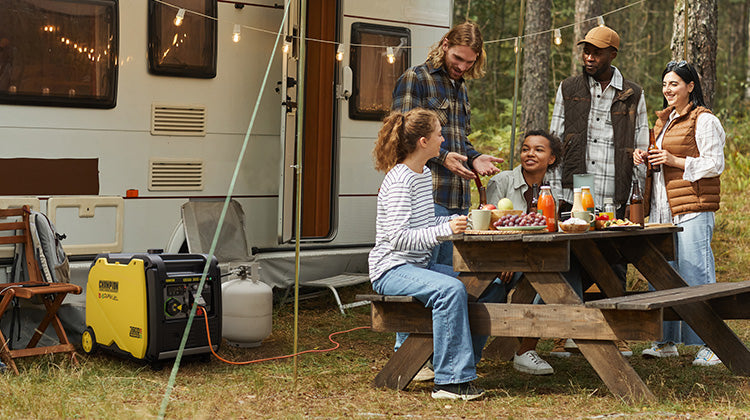
At a glance: choosing a generator for your caravan
- Start with the appliances you want to power, then allow for both running and starting wattage.
- A compact inverter generator is often a practical choice for caravan use, particularly when portability and noise matter.
- Petrol generators give you a straightforward portable power option, while dual-fuel models let you choose between petrol and LPG.
- Check weight, runtime and noise alongside power output. You'll need to transport and store the generator as well as run it.
- Always check campsite rules before taking a generator, as restrictions on generator use can vary between sites.
Choosing a generator for your caravan is about getting enough power without carrying more size and weight than you need.
Your appliances determine the output. Noise, portability, runtime and fuel choice determine how well the generator fits the way you travel.
For many caravan setups, we’d start with a compact petrol or dual-fuel inverter generator.
Work out your electrical load first, then compare generators that comfortably cover it.
How much generator power does a caravan need?
There's no single generator size that's right for every caravan. It depends on what you plan to run and which appliances you'll use at the same time.
Your list might include:
- Fridge
- Lighting
- TV
- Phone and laptop chargers
- Water pump
- Microwave
- Kettle
- Other small electrical appliances
Check the running wattage of each appliance and add together anything you're likely to use at the same time.
You should also account for starting wattage. Equipment containing motors or compressors can briefly draw more power when starting than it needs during normal operation.
Getting the generator size right means you'll have enough power for your appliances without choosing a generator that's larger, heavier or more powerful than you actually need.
What type of generator is best for a caravan?
For many caravan owners, an inverter generator is a sensible place to start.
Inverter generators electronically process their output to provide controlled power suitable for electronic equipment. Many inverter generators are also compact and designed for quieter operation, which can make them more practical when you're travelling.
A smaller inverter model may be enough for charging devices, lighting and other lighter loads. If you want to run higher-wattage appliances, you'll need to look further up the output range.
Portability is another advantage. You're carrying the generator alongside everything else you need for a trip, so a compact model that's easy to lift and store can make a noticeable difference.
Once you know how much power you need, compare your options based on output, fuel type, weight and noise. That will give you a much better idea of what will work for the way you travel.
Is a petrol generator suitable for a caravan?
A petrol generator can work well for caravan trips because portable models are available across a useful range of outputs.
A compact petrol inverter generator can be a practical choice when you need something that's easy to transport and store. Matching the output to your appliances also helps you avoid taking a larger generator than you need for occasional power away from home.
Think about how you'll physically handle the generator too. Weight and dimensions can make a noticeable difference when you're regularly lifting it in and out of a vehicle or caravan storage area.
What about a dual-fuel generator for a caravan?
A dual-fuel generator lets you run on petrol or LPG, giving you more flexibility over your fuel supply.
That may be particularly useful for caravanners who already travel with an LPG setup. LPG also avoids some of the storage considerations associated with keeping petrol for extended periods and has lower emissions, lower maintenance costs and a range of other benefits.
There is one important specification to check. Some dual-fuel generators have a different rated output when running on LPG rather than petrol. Make sure the available output on the fuel you intend to use is enough for your caravan appliances.
How important is generator noise when caravanning?
Noise should be high on your list when you're choosing a caravan generator. Even a generator that doesn't sound particularly loud at home can become noticeable on a quiet campsite.
Manufacturers usually state noise in decibels (dBA). When comparing figures, check the distance and operating conditions used for the measurement. Two dBA figures aren't necessarily comparable if they've been measured differently.
Inverter generators are often a good place to look when quieter operation is important. Just remember that noise is one part of the decision. The generator still needs enough output for your appliances.
How much generator runtime do you need?
Think about how you'll actually use the generator during a typical trip.
If you only need occasional power for charging and a few appliances, long continuous runtime may be less important. If the generator will be used for several hours, fuel capacity and runtime become more relevant.
When comparing generator runtime, check the electrical load used to calculate the manufacturer's figure. Runtime stated at a low percentage load won't necessarily reflect what you'll get when powering several appliances.
That makes your expected load just as important as the size of the fuel tank.
What size and weight should you look for?
A caravan generator has to travel with you, so portability isn't a minor detail.
Check the:
- Generator weight
- Overall dimensions
- Carrying handles
- Available storage space
- Amount of fuel you'll need to carry
- Distance you'll regularly move the generator
There's little benefit in buying considerably more output than you need if the result is a generator that's difficult to transport.
For caravan use, enough power in a practical package is generally more useful than chasing the highest possible wattage.
Do you need a diesel generator for a caravan?
For most caravan applications, we'd look at petrol and dual-fuel options first.
Diesel generators can make sense for sustained use and heavier electrical loads, but those strengths often come with size and weight considerations that are less attractive when you're touring.
If you have unusually demanding power requirements, diesel may still be worth considering. Fuel type should follow the job, though. Don't choose diesel simply because you expect to use the generator regularly.
Can you use a generator at a UK campsite?
Not necessarily. Campsite rules vary, so check before you travel.
Some sites may restrict generator use completely. Others may allow generators only during certain hours or have rules designed to limit disturbance to other guests.
A quiet generator still won't be permitted on every campsite. If generator power is important to your trip, check directly with the campsite before booking or travelling.
How do you use a caravan generator safely?
Never run a portable generator inside your caravan, awning or another enclosed or partially enclosed area.
Generators produce carbon monoxide, a poisonous gas that you can't see or smell. Always operate the generator outdoors and follow the manufacturer's requirements for positioning, ventilation and clearance from occupied spaces.
You should also:
- Keep the generator on a suitable stable surface
- Keep exhaust gases away from people and occupied areas
- Follow the manufacturer's fuel-handling instructions
- Use appropriate electrical connections
- Protect the generator as specified for the conditions
- Allow it to cool before refuelling where instructed
Don't move a running generator somewhere unsafe simply to reduce the amount of noise reaching your pitch.
Caravan generator buying checklist
Before you choose, check:
- What appliances do I need to power (at the same time)?
- What's their combined running wattage?
- Do any have a higher starting wattage?
- Which appliances will run together?
- Would an inverter generator suit my setup?
- Do I prefer petrol or petrol/LPG dual-fuel?
- How much does the generator weigh?
- Where will I store it while travelling?
- How noisy is it and how was that figure measured?
- How much runtime do I need?
- Does my usual campsite allow generators?
Answer those questions first and you'll have a much clearer idea of which specifications actually matter for your caravan.
Need help choosing a generator for your caravan?
The right caravan generator should cover your appliances without adding unnecessary weight, bulk or noise to every trip.
Start with your running and starting wattage, then compare fuel type, runtime, noise and portability.
If you’re unsure what output suits your caravan, use our chat system by listing what you want to power and how you travel and we can narrow down the options that fit your setup.


