
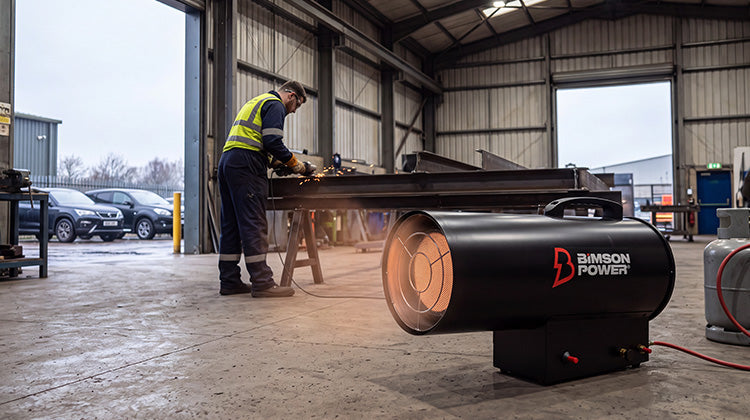
Choosing the right size heater is essential if you want to keep a workshop, garage, warehouse, construction site or other working space warm during the colder months.
A heater that is too small may run continuously without bringing the space up to the required temperature. On the other hand, choosing a heater that is significantly larger than necessary can increase fuel consumption and running costs.
So, what size propane or diesel heater do you need?
The answer depends on several factors, including the size of the space, ceiling height, insulation, ventilation, how often doors are opened and the temperature you want to achieve.
In this guide, we'll explain how to estimate the heating output you need and how to choose between a propane and diesel space heater.
At a glance: choosing the right heater size
- Calculate the volume of the space in cubic metres (m³) rather than looking only at floor area.
- Consider insulation, draughts, open doors and other sources of heat loss.
- A larger or poorly insulated space generally needs more heating output.
- Heater output is measured in kilowatts (kW), with higher kW ratings providing more heat.
- Propane heaters can provide high-output portable heating where suitable ventilation is available.
- Diesel and kerosene heaters are useful for workshops, industrial spaces, construction sites and other demanding applications.
- Always check the manufacturer's stated heating area or volume alongside the output rating.
- Direct-fired heaters require appropriate ventilation because combustion gases are released into the surrounding space.
Why does heater size matter?
The main purpose of a space heater is to replace the heat that is being lost from a building or working area.
A well-insulated workshop with closed doors will retain heat more effectively than an uninsulated warehouse with large roller doors opening throughout the day.
This means two buildings with the same floor area can require very different heater outputs.
For example, a small but poorly insulated workshop may need more heating capacity than a larger, well-insulated room.
Getting the size right can help you:
- Reach the desired temperature more effectively
- Maintain a comfortable working environment
- Avoid running a heater continuously at maximum output
- Reduce unnecessary fuel consumption
- Choose equipment that is appropriate for the space
The first step is therefore to look at the volume of the area you need to heat.
How do you calculate the size of heater you need?
Start by calculating the volume of the space.
The formula is:
Length × Width × Height = Volume in m³
For example, a workshop measuring:
10m long × 8m wide × 4m high
would have a volume of:
10 × 8 × 4 = 320m³
You can then use the volume, together with the insulation and ventilation characteristics of the building, to estimate the heating output required.
A common starting point for industrial and workshop spaces is to allow roughly 30–60 watts of heating output per cubic metre, depending on insulation and heat loss. This is only a guide; actual heat requirements can vary significantly between buildings.
For example:
320m³ × 40W = 12,800W
That is approximately:
12.8kW of heating output
A space with greater heat loss could require considerably more.
What affects the amount of heating you need?
Calculating the volume is only part of the process.
Several other factors can increase the amount of heat required.
Insulation
Insulation has a major effect on how quickly a building loses heat.
A well-insulated workshop can retain warmth considerably better than an uninsulated steel building.
When estimating heater size, consider:
- Wall insulation
- Roof insulation
- Doors and windows
- Floor construction
- Gaps and draughts
- Overall building construction
A poorly insulated or draughty building will generally require a higher heating output.
Ceiling height
Don't calculate heater requirements using floor area alone.
A workshop measuring 100m² with a 2.5m ceiling contains 250m³ of air.
The same 100m² workshop with a 5m ceiling contains 500m³.
The second space therefore has twice the air volume to heat.
This is why cubic metres are more useful than square metres when estimating space-heater requirements.
Doors and ventilation
Opening large doors can allow a significant amount of warm air to escape.
This is particularly relevant to:
- Workshops
- Warehouses
- Agricultural buildings
- Vehicle workshops
- Construction sites
- Loading areas
If a roller shutter or workshop door is regularly opened, the heater may need to replace heat much more quickly than in an enclosed room.
What size propane heater do I need?
Propane heaters are available in a range of outputs and can provide rapid heating for workshops, garages, site areas and other suitable spaces.
We currently offer propane heaters from 15kW to 50kW.
As a general starting point:
| Heater output | Example application |
|---|---|
| 15kW | Smaller workshops and industrial spaces |
| 30kW | Larger workshops and working areas |
| 50kW | Larger industrial spaces and high-demand heating |
These are not strict room-size limits. The actual requirement depends on insulation, ceiling height, ventilation and heat loss.
For example, the 15kW propane heater is specified for spaces up to approximately 300m³, while the 30kW propane heater is specified for spaces up to approximately 700m³.
When is a propane heater suitable?
Propane can be a practical choice when you need:
- Fast heat
- Portable heating
- High heat output
- A fuel source that is easy to transport
- Heating for workshops or temporary work areas
Propane heaters are particularly useful where mains electricity is unavailable or where a high-output electric heater would not be practical.
However, combustion heaters require suitable ventilation. Always follow the manufacturer's instructions regarding ventilation, positioning and operation.
What size diesel heater do I need?
Diesel/kerosene heaters are commonly used for larger workshops, industrial spaces, construction sites, agricultural buildings and other demanding applications.
Our current diesel/kerosene range includes 20kW, 37kW and 63kW models.
As with propane heaters, the correct size depends on the characteristics of the space.
For example, the 37kW diesel/kerosene heater produces 37kW of heat and is designed for heating large spaces. The specification lists an airflow of 1,100m³/h and a fuel consumption of approximately 3.8 litres per hour.
A diesel heater can be particularly useful where you need:
- High heat output
- Heating for larger working areas
- Portable industrial heating
- Longer periods of operation
- A liquid-fuel heating solution
Propane vs diesel heater: which should you choose?
Both propane and diesel heaters can provide high-output heating, but the most suitable option depends on your environment and fuel requirements.
| Requirement | Propane heater | Diesel/kerosene heater |
|---|---|---|
| Fast portable heating | ✓ | ✓ |
| Smaller workshops | ✓ | ✓ |
| Larger industrial spaces | ✓ | ✓ |
| High heat output | ✓ | ✓ |
| LPG fuel available | ✓ | — |
| Diesel/kerosene readily available | — | ✓ |
| Liquid fuel storage preferred | — | ✓ |
| Temporary site heating | ✓ | ✓ |
Fuel availability is an important consideration.
If your business already has access to LPG cylinders, propane may be convenient. If diesel or kerosene is readily available on site, a diesel/kerosene heater may be more practical.
The heating environment is equally important.
What size heater do I need for a workshop?
Workshops vary considerably in size and construction, so there isn't a single heater output that suits every workshop.
As a starting point, calculate the volume of your workshop and then consider its insulation and heat loss.
For example, a workshop measuring 10m × 8m × 4m has a volume of 320m³.
A well-insulated workshop with relatively few draughts may require considerably less heat than a similar-sized uninsulated workshop with large doors opening regularly.
The 15kW propane heater is rated for spaces up to approximately 300m³, making this output range relevant to smaller industrial spaces. Larger workshops may require 30kW, 37kW or 50kW equipment depending on their characteristics.
What size heater do I need for a warehouse?
Warehouses can be more difficult to heat because of their size, ceiling height and frequent air movement.
A large warehouse with a high roof can contain a substantial volume of air, while loading doors can allow heated air to escape regularly.
When choosing a warehouse heater, consider:
- Total building volume
- Ceiling height
- Insulation
- Number and size of doors
- How often doors are opened
- Desired internal temperature
- Whether the entire building needs heating
- Whether particular working areas need targeted heating
For larger or complex buildings, a proper heat-loss calculation is preferable to relying solely on a general rule of thumb.
What size heater do I need for a garage?
Garages are often smaller than workshops or warehouses, but they can still lose heat quickly if they have uninsulated walls, concrete floors or large doors.
For a garage or small workshop, calculate the volume first and consider how well the space retains heat.
If the garage is well insulated and doors remain closed, a lower-output heater may be sufficient.
If it is draughty, uninsulated or frequently opened to the outside, you may need a higher-output heater.
What size heater do I need for a construction site?
Construction sites can present particularly challenging heating conditions.
Temporary buildings, unfinished structures, open doors and poor insulation can all increase heat loss.
A heater may be required to warm:
- Site cabins
- Workshops
- Temporary work areas
- Partially enclosed buildings
- Storage areas
- Construction areas
For an enclosed site cabin, a relatively small heater may be sufficient. Larger unfinished buildings may require significantly more output.
The condition of the building is therefore just as important as its size.
Don't choose a heater based on floor area alone
One of the most common mistakes when choosing a space heater is looking only at square metres.
For example, two workshops may both measure 200m²:
Workshop A
- 200m² floor area
- 2.5m ceiling
- Well insulated
- Doors usually closed
Workshop B
- 200m² floor area
- 5m ceiling
- Poorly insulated
- Large roller doors opened regularly
Workshop B contains twice the air volume and is likely to lose heat much faster.
It could therefore require a substantially higher heater output.
This is why heater sizing should consider volume, insulation and heat loss, rather than floor area alone.
What happens if a heater is too small?
An undersized heater may struggle to reach the required temperature.
It can end up operating continuously without providing enough heat to overcome the heat being lost from the building.
You may notice:
- The space never reaches the desired temperature
- The heater runs constantly
- Workers remain uncomfortable
- Fuel is being used without achieving the expected result
If your calculated requirement is close to the output of a particular heater, consider the building's heat loss before making the final choice.
What happens if a heater is too large?
A heater that is substantially larger than necessary may provide more heat than the space requires.
This can result in:
- Higher fuel consumption
- More frequent temperature cycling
- Unnecessary operating costs
- Difficulty maintaining a consistent temperature
The goal is not to buy the biggest heater available.
The goal is to select enough heating capacity to overcome the heat loss from the space and achieve the required working temperature.
Direct-fired propane and diesel heaters need ventilation
This is particularly important when choosing a combustion heater.
Direct-fired propane and diesel/kerosene heaters release combustion products into the surrounding environment. They therefore require adequate ventilation and must be used according to the manufacturer's instructions.
Do not operate a direct-fired heater in an enclosed area without the ventilation required by the manufacturer.
For workplaces, consider the specific environment, the people working there and the requirements for safe ventilation.
Where combustion gases cannot safely be released into the occupied space, a different type of heating system, such as an indirect-fired heater with externally vented exhaust, may be more appropriate.
How much fuel will a heater use?
Fuel consumption depends on the heater, its output setting and how long it operates.
Always check the manufacturer's stated fuel consumption rather than assuming that a larger heater will always use a fixed amount of fuel.
For example, our 37kW diesel/kerosene heater is specified at approximately 3.8 litres per hour.
The 15kW propane heater is specified at approximately 1.07kg of LPG per hour at 100% load, with lower consumption at reduced output.
When estimating running costs, consider:
- Heater output
- Typical operating setting
- Hours of operation
- Fuel consumption
- Local fuel prices
- How well the building retains heat
Improving insulation and reducing unnecessary heat loss can therefore have a significant effect on heating requirements and running costs.
A quick guide to choosing your heater size
If you're looking for a starting point, our current range covers the following output classes:
| Output | Fuel | Example use |
| 15kW | Propane | Smaller workshops and industrial spaces |
| 20kW | Diesel/Kerosene | Workshops and medium-sized working areas |
| 30kW | Propane | Larger workshops and industrial spaces |
| 37kW | Diesel/Kerosene | Large workshops and working areas |
| 50kW | Propane | Larger industrial spaces |
| 63kW | Diesel/Kerosene | High-output heating for large spaces |
These should be treated as a guide rather than a guaranteed room-size calculation. Your building's volume, insulation and ventilation requirements should all be considered before choosing a heater.
What information do you need to choose the right heater?
Before choosing a propane or diesel heater, make a note of:
1. Length, width and height
Use these measurements to calculate the volume in cubic metres.
2. Insulation
Consider whether the walls, roof and doors are insulated.
3. Doors and openings
Think about how often doors are opened and how much outside air enters the building.
4. Desired temperature
Decide how warm you need the space to be.
5. Current temperature
The colder the starting environment, the more heat may be required to reach your target temperature.
6. Fuel availability
Consider whether propane, diesel or kerosene is easiest to source and store.
7. Ventilation
Make sure the heater is suitable for the environment and that adequate ventilation can be provided.
Choose the right heater for the space
There is no single heater size that works for every workshop, warehouse, garage or construction site.
Start by calculating the volume of the space, then consider insulation, draughts, door openings and the temperature you want to achieve.
For smaller industrial spaces, a 15kW propane heater may provide the required output. Larger workshops and industrial areas may require 30kW, 37kW or 50kW heating, while very large spaces may need 63kW or multiple heaters.
The right fuel also depends on your working environment and what fuel is readily available.
If you're unsure what size propane or diesel heater you need, use our chat system by entering the dimensions of your space, insulation level, intended use and fuel preference. These details will help narrow down the heater output and type that best suits your application.


